‘Electricity is a ghost’: The Nevada substation attack and the extremist threat to the power grid

“Do not do any of these things. Especially do not cover your face and destroy the many, and largely unprotected, power stations and cell towers. Electricity is a ghost, but one you can catch and kill. Do not do that. Do not become the sort of person who gets really good at blowing up power plants while never getting caught.”
This quote — which follows a style commonly observed in extremist propaganda that tells followers to “not” do a described intended act in the belief that the negative wording legally insulates them from incitement — has been used in numerous violent extremist memes and abridged tweets, sometimes accompanied by imagery of power components or a masked individual standing in front a substation’s fence. It comes from “Harassment Architecture,” a 2019 book self-published by accelerationist ecofascist Pine Tree Party founder Mike Ma, who subsequently published “Gothic Violence” in 2021.
Both of these books were found in the possession of a law-school student who rammed a remote power substation in Nevada on Thursday morning.
According to the Las Vegas Metropolitan Police Department, the Boulder City Police Department received a call at about 10 a.m. that a vehicle had sped through a chain-link security fence protecting a Los Angeles Department of Water and Power substation south of Las Vegas and crashed into large reels of industrial wire. The driver, Dawson Maloney, 23, of Albany, N.Y., died of an apparent self-inflicted gunshot wound at the scene.
It’s believed that Maloney rented a car on Feb. 12 and left New York on Feb. 14. The FBI’s Albany office said a missing-person report had been filed with local police after those close to him became concerned about Maloney’s absence. That report “indicated the subject had sent several messages to family and friends that were suicidal and again indicative of terrorism ideologies,” the FBI said, and evidence collected at his Albany home and dorm room included “several gun components needed to assemble a firearm” and a 3D printer.

Two shotguns, a tactical rifle, ammunition, two commercial-grade flame throwers, explosive precursor chemicals, body armor and electronics were seized from Maloney’s vehicle at the substation, the FBI said. In his Boulder City motel room, investigators found additional ammunition, precursor chemicals and “literature indicative of domestic terrorism ideologies.”
Las Vegas police released security camera footage of Maloney’s sedan accelerating toward the gate, then swerving and easily plowing through the perimeter fence in the direction of the substation. They said thermite, ammonium nitrate, magnesium ribbon, metal pipes and gasoline were among the materials seized from the vehicle and motel room, along with a crowbar and a hatchet.
In addition to the Mike Ma books, Las Vegas police photos show that Maloney had a trio of 1960s Army handbooks on evasion and escape, incendiaries and improvised munitions. The last handbook, in particular, is routinely observed in online domestic extremist forums where individuals share written and video materials on tactics.
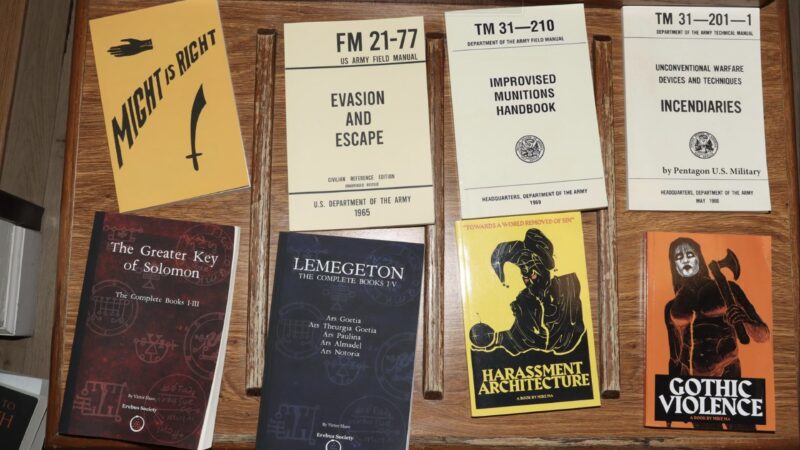
LVMPD Sheriff Kevin McMahill told reporters on Friday that Maloney referred to himself as his mother’s “dead terrorist son” in a final message and allegedly alluded to others that he would be committing an act that would land him “on the news.” McMahill referred to “this smorgasborg of radical literature that is there, something we’ve seen in the last couple of years,” and said investigators were working through the clues left behind by Maloney as they worked to determine a motive.
Extremists of varying ideologies, though, have expressed support for attacking critical infrastructure sectors. ISIS propaganda encouraged attacking critical infrastructure, including power, as an expedient way to sow chaos. While anti-government extremism, politically motivated violence, conspiracy theory extremism, radical environmentalism or ecofascism (white supremacism combined with radical environmentalism) are among the ideologies with varying motivators that may drive them to attempt infrastructure attacks, these targets particularly mesh with the accelerationist aim of bringing about the downfall of modern society in order to rebuild an exclusively white society from the ashes.
A 261-page guide that was produced and distributed in 2022 by the accelerationist Terrorgram Collective contained at least 45 pages centered on critical infrastructure attacks, from brief memes to detailed tips. An earlier Terrorgram handbook declared that “so long as the power turns on, the status quo, the downward decline of our race, and the increase in nonwhites in our lands will carry on unhindered.”
In February 2025, neo-Nazi accelerationist Brandon Russell of Orlando, Fla., was sentenced to 20 years in prison for plotting attacks against multiple substation transformers around Baltimore in order to cause a “cascading failure.” According to the Justice Department, his partner in the plot, Sarah Beth Clendaniel, a Maryland woman who was sentenced for her role in 2024, said that by hitting multiple locations in one day they “would completely destroy this whole city,” and that a “good four or five shots through the center of them … should make that happen.”
An earlier white supremacist plot to attack the power grid included former Marines with a mission of “knocking down The System, mounting it and smashing it’s [sic] face until it has been beaten past the point of death,” according to group discussions relayed in the Justice Department’s indictment. The DOJ said the group also “discussed using homemade thermite to burn through and destroy power transformers” and “researched, discussed and critically reviewed at length a previous attack on the power grid by an unknown group” that involved using “assault-style rifles in an attempt to explode a power substation.”
Extremists particularly derive inspiration from the unsolved attacks on energy infrastructure that have been elevated to folkloric status in propaganda materials.
This includes the 2013 nighttime attack on the Pacific Gas and Electric Company’s Metcalf Transmission Substation south of San Jose, Calif., in which $15 million in damage was caused to 17 transformers by a spray of gunfire from outside the perimeter fence. There have been no arrests of the gunmen, and the shadowy surveillance footage that shows sparks from bullets hitting the chain-link fence has been widely circulated in extremist forums.
While online extremist forums laud Metcalf as an example of how to hit critical infrastructure and get away with it, PG&E customers didn’t take much of a hit that night. It was a different story in Moore County, N.C., in 2022, when two Duke Energy substations were hit by gunfire in what Sheriff Ronnie Fields called “a targeted, intentional attack.”
More than 45,000 people were left without power for a week and the death of an 87-year-old woman, who relied on oxygen, during the blackout was ruled a homicide. The multi-agency investigation into the attacks “remains active and deliberate,” Fields said in a December statement marking the three-year anniversary of the attacks, but there have been no arrests. North Carolina subsequently enacted a law that increases punishment for attacks on electricity infrastructure.
Even violent extremists who have cited unrelated motivations for their attacks have lauded the prospect of attacking critical infrastructure. Juraj Krajcik, who killed two people outside of a Bratislava bar in 2022, targeted the LGBT community in that attack but left behind an online manifesto that was quickly circulated among far-right extremists in which he encouraged others to “target infrastructure; destroy necessary utilities in non-White or jewish areas – electricity, water supply, sanitation, fiber-optic cables, cell towers.”
In its Critical Infrastructure Protection Roadmap released in January, the North American Energy Reliability Corporation (NERC) said that “theft, ballistic damage, vandalism, and intrusion (tampering) all pose physical security risks to grid assets which could impact reliability.”
“The current challenges around the manufacture of transformers or similar equipment in a timely manner and resulting supply shortages could aggravate risk by inhibiting system restoration from a natural disaster or man-made attack,” NERC warned, citing a “Metcalf style coordinated ballistic attack” as one potential scenario along with cuts to fiber optic cables or the theft of copper grounding from substations.
Read More


